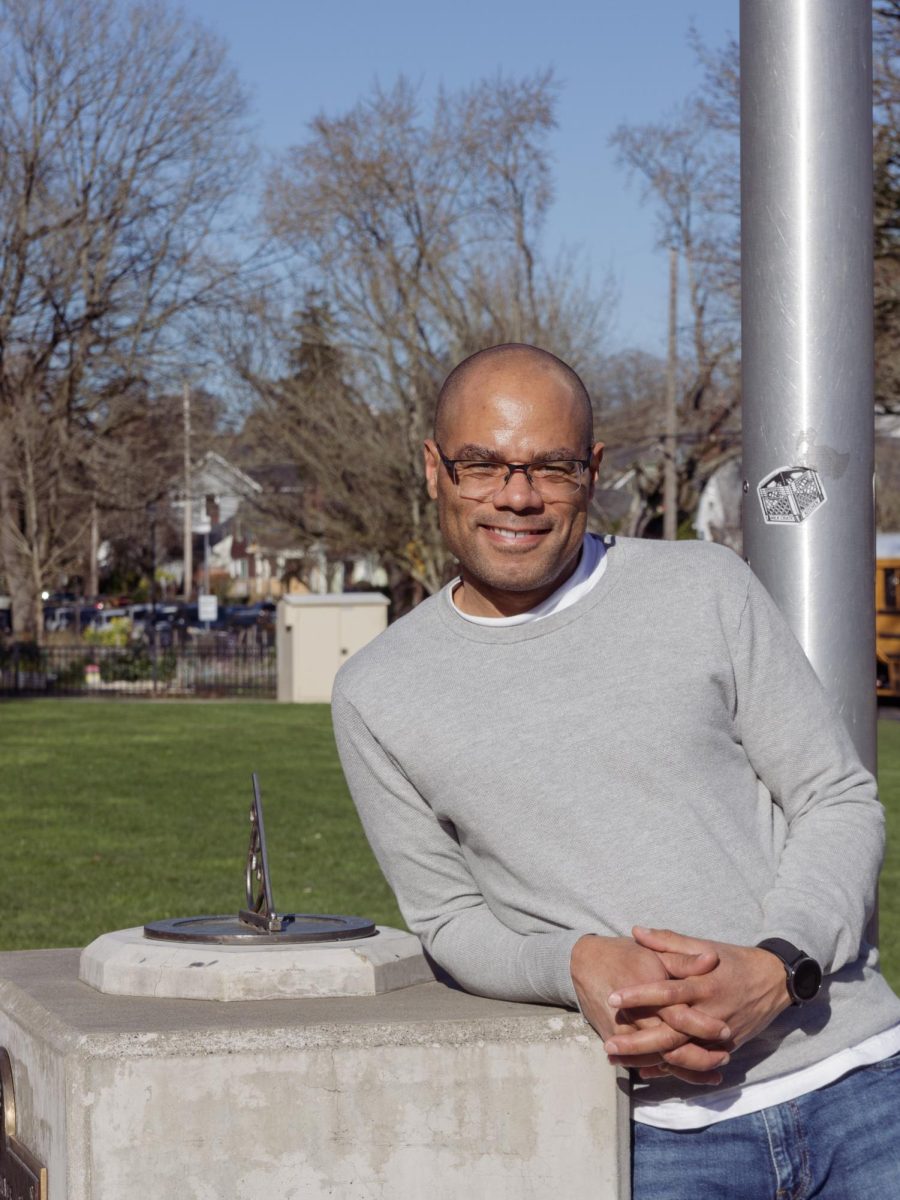

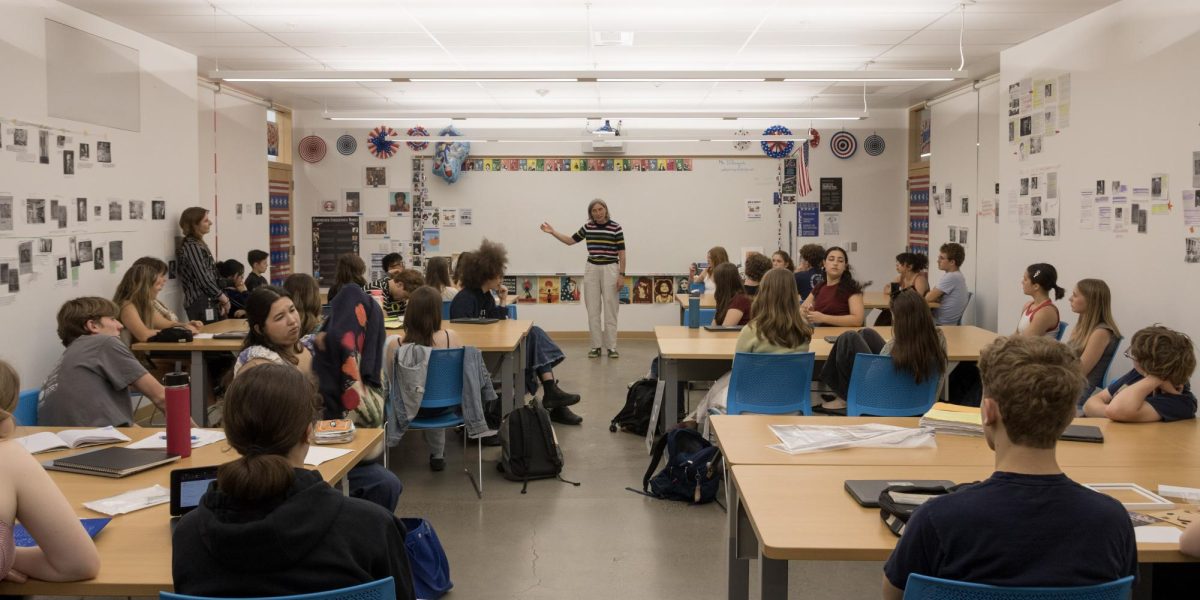

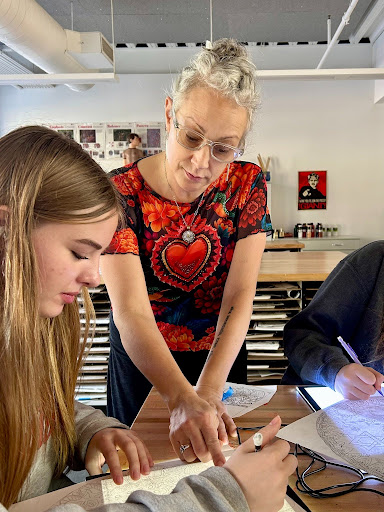
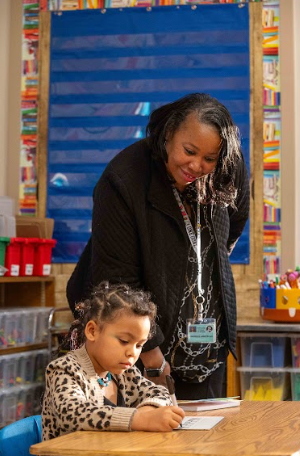









From their time as classmates at Sabin Elementary School and Beaumont Middle School to their current positions as coworkers at Grant High School, old ties remain strong for Michela Byrne, Sharitha McKenzie and Erin McNulty.
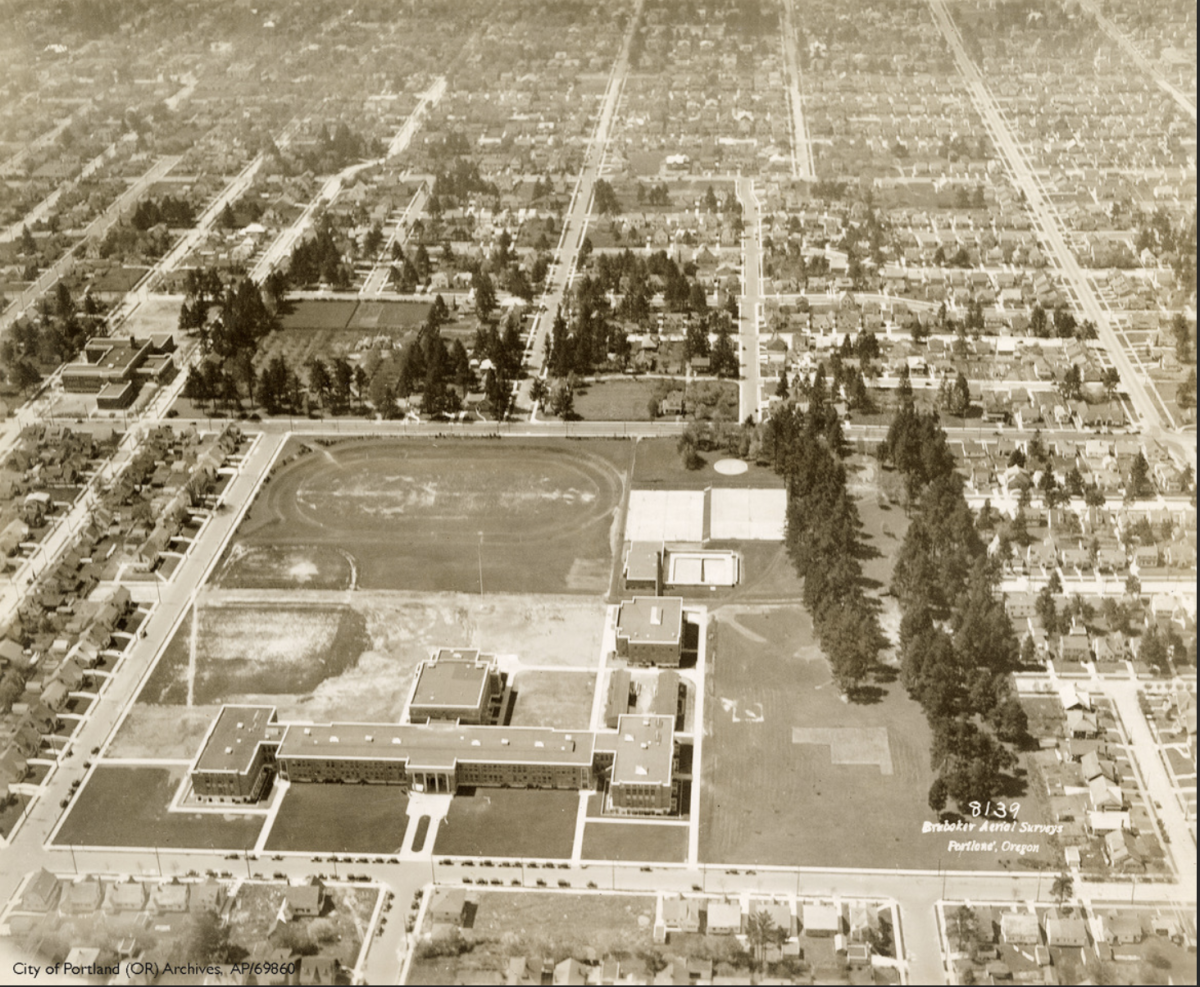
Sabin, an elementary school lying just northwest of Grant, hosts a body of approximately 325 students. It has offered education to students from the Grant cluster since 1928. From 1988 to 1994, Byrne, McKenzie and McNulty, Grant English teacher, counselor and P.E. and health teacher, respectively, attended the school. The lasting ties they built at Sabin have made working together at Grant a carousel of memories which would make leaving the school incredibly difficult.
When their parents were looking for elementaries to enroll their kids in, Sabin’s full-day student daycare program stood out, a rarity in schools when Byrne, McKenzie and McNulty were growing up. For McNulty’s parents, who both worked full time, this was a strong pull factor.
It was a similar case for McKenzie, whose home address was actually within the Faubion PK-8 School boundary. Her parents decided to use her grandparents’ address to get her into Sabin. She would meet with her cousins each morning and the group would walk together to school. For McKenzie, the Sabin community was family in both a figurative and traditional sense.
Byrne grew up in the Sabin district. When she reached kindergarten age, Byrne’s parents considered sending her to a Catholic school. However, Chris Lamp, her father’s cousin and a teacher at Sabin, recommended she attend the school he worked at, which was located just down the street from them. Byrne is glad for the experiences his suggestion gave her. Lamp wound up being her and McKenzie’s kindergarten teacher, and it was in his class that they would meet for the first time.
Through their years at Sabin, Byrne, McKenzie and McNulty would at various times end up being in the same class — but even when they weren’t, their lives still found ways to intertwine. In third grade, McNulty would often go over to Byrne’s house in the mornings for breakfast before walking to school. At recess, playing four square and spinning on bars on the playground brought together students from the whole school.
The community involvement and connection at Sabin was unparalleled by any other school the trio attended. Students would come together in assemblies, to sing songs like the Black National Anthem and to create art that can still be seen on the campus today. One project which they worked on in kindergarten was a mural. Each student was assigned a different piece of it to create. “For years, I used to be like, ‘That’s the antelope I painted,’” McNulty says. Byrne remembers being given a rock to paint, while McKenzie remembers being told that she couldn’t participate: “Even though (I was) in Mr. Lamp’s art class — that’s what I call kindergarten.”
Besides activities, the bonds they built from Sabin’s community remain warm in their memories. Byrne, who recalls being more sensitive when she was younger, remembers instances when her kindergarten classmates would comfort her — even recollecting a moment at Sabin with the current head coach of Grant’s boys soccer team, Erik Miller. “I used to take the bus to Alameda and walk with Connor Maloney to (my babysitter’s) house and she would watch me when I was really little. I guess it was one day a week that I used to take swimming and so Connor knew not to wait for me on those days, but my mom had forgotten to tell him that it ended,” Byrne says. “I got off and I couldn’t find Connor, and I was in kindergarten, and so I just burst into tears, and Erik Miller observed this whole situation, looks ahead down the street and is like, ‘There’s Connor! I gotta go get him! He needs to help Michela!’”
While the memories they built in the halls of Sabin are incredibly strong, those from their after-school activities were a near second. Since elementary school, sports have filled the free time of Byrne, McKenzie and McNulty. It was in these spaces that their lives would intertwine even further.
Byrne and McKenzie played soccer together in elementary school and McNulty and McKenzie were on the same basketball team in middle school, but if a venn diagram of sports which related Byrne, McKenzie and McNulty was drawn, track and field would be at the center. In high school, all three competed in their own track events — Byrne and McNulty at Grant as a distance runner and thrower, respectively, and McKenzie at Benson Polytechnic High School as a sprinter. During their senior year, all three were written of in a Portland Tribune article in the leadup to the 2001 state championships.
Though they all began going in different directions after graduating from high school — Byrne even leaving the country to teach in South America — the three can agree to feeling a connection back to the Grant neighborhood. “I always say Northeast Portland is a bit of a vortex because it kind of calls people back,” McNulty says. “If you end up back in the Portland area, there is something where if you can afford to find a way to be somewhere attached, there’s a little bit of a (pull) calling you home.”
Ties to Portland would draw McKenzie back to working in Portland Public Schools (PPS) just as her mother had done. While working at Whitaker Middle School, McKenzie’s mother led an investigation into radon and asbestos infiltration on the campus which would lead into the school’s closing in 2001. The experience of growing up Black and feeling like she couldn’t trust her own district holds strong in McKenzie’s conscience each morning as she brings her own water from home to drink while working in her office at Grant.
Memories from the school last in other ways too: The remains of the Whitaker campus today are a mere field at Fernhill park, but for McNulty, whose basketball and volleyball practices were held there, and McKenzie, who spent many an afternoon after school with her mother at the campus, the past image lingers.
Similar things can be said for the rest of Portland since their time in high school. Gentrification since the ‘90s has completely reshaped the city — that all three can certainly attest to. Walking along streets like Mississippi today, McKenzie recognizes a “weird feeling.” She says, “People who weren’t Black never came to those neighborhoods.” The one area which seems to have remained unchanged is the Grant neighborhood. “It’s always just been very wealthy, old money,” McNulty says. “There’s no way my family would have lived where we lived if it hadn’t been my grandparents’ house.” The community they experienced at Sabin was much more diverse, on many fronts.
Sabin, in comparison to Beaumont, Grant or Benson, seems to have had a particular impact on the perspectives of Byrne, McKenzie and McNulty to this day. McKenzie attributes this to being surrounded by people of various racial and socioeconomic backgrounds from such a young age. She believes this special feature of Sabin gave them all a baseline understanding which has allowed them to become more supportive and likeable figures for students. Their time at Sabin gave them a smooth transition into their roles at Grant.
McKenzie was a counselor at Jefferson High School before she came to Grant. There, she would get to know Grant Principal James McGee, who was her intern. After he landed his current position, he invited McKenzie to work at Grant with him. The bond she built with McGee at Jefferson and the rarity of working with a principal who had studied, let alone understood, the role of a counselor drove her to make the switch, and she began working at Grant in 2021. While she’s had a great time counseling at Grant, one thing McKenzie enjoyed particularly about her time at Jefferson was the diversity of the student body.
McNulty taught health at McDaniel High School before she came to Grant. She had been looking for a steadier position, and so when Grant was searching for P.E. and health teachers to aid the overwhelming number of students lacking the credits, she applied. The second she set foot into the building again she was greeted by familiar faces: Carol Campbell, who had been the JV coach for volleyball while she played at Grant, and Debbie Engelstad, who was her ninth grade P.E. teacher, were among the people interviewing her. Soon after a successful interview, she would begin teaching alongside her former teacher and continued to do so for the next decade, until Engelstad retired. Students of theirs remember the teachers’ compatibility and friendship as they co-taught Fit to Live and Learn, a model of freshmen P.E. borrowed from Benson.
Byrne began teaching English at Grant in 2022, after both McKenzie and McNulty had started working at the school. She remembers feeling anxious to return to the school on her first day, but says that recognizing the familiar faces of past classmates made her feel quickly at home. Despite the extra years that have passed since, Byrne and McKenzie feel stronger ties to their elementary school than their high school years. The classmates which crowd these memories aren’t cemented as characters of the past, either: Familiar faces from Sabin pop up everywhere for Byrne, McKenzie and McNulty, whether that’s coaches on Grant’s fields who attended the school, the daughter of their fourth grade classmate whose face they recognized but just couldn’t put a finger on until the parents’ meeting, the lady next to them at the hair salon or the man towing their car. Small moments of reunification are like little resurgences of memory as they recognize each others’ faces and respond with a shocked first-and-last name exclamation: “Sharitha McKenzie?”
As she navigates through adulthood, McKenzie holds dear the lasting ties she has with her former classmates. Even if they weren’t best friends, they shared the same experiences and spaces for years. “It feels cool to be able to remember (and tell) stories, and then how we remember them different. You can’t just do that with anybody,” McKenzie says. “It’s really nice to be able to have that familiarity. Like, I don’t have to explain who I am — they already know.”
To Byrne, McKenzie and McNulty, these kinds of preeminent bonds between coworkers seem to have translated into a better experience for students as well. Sharing past memories and normalizing that link seems to be a central piece in establishing a trusting, true and effective bond between teachers and students.
“What I find myself doing a lot is like, when kids mention Ms. Byrne (or) Ms. McKenzie, I’m like, ‘Oh, I’ve known them for like my whole life,’” says McNulty. “They’re like, ‘Really?’ I’m like, ‘You guys, we are a product of the same schooling system that you’re moving through.’ And so it feels nice to have that shared experience and then now be giving back to the next generation and just be like, ‘Okay y’all, I promise you, I’ve been in Portland; I’ve been in your shoes. It’s going to be way different now, but we’ve been through a lot of that.’ And hopefully as the next generation comes into education, some of them can (take that with them).”
Byrne, McKenzie and McNulty rarely find the time to catch up, but when they do, memories bubble up and they can talk endlessly about where their old classmates have gone now. In moments like these, it’s as if their memories, though decades old, are just as clear as yesterday.