
























Practiced in gyms, outdoors and on walls anywhere from five to 3,000 feet, rock climbing is a sport requiring strength, complex technical skills and problem solving; its multifaceted nature appeals to a diverse group of people. The climbing community — though often overlooked in comparison to mainstream sports — has a sizable presence in the U.S., and Grant High School is no exception: Both students and teachers climb avidly, representing multiple styles of climbing and many levels of experience.
Those who don’t climb are often unaware of the variety offered by the sport. According to Alek Zavertnik, a climber and sophomore at Grant, many people think of climbing solely as top-roping, also known as sport climbing. This type of climbing involves ascending high walls while harnessed to a rope already suspended from the top of the wall. In reality, there are several other variations of climbing which many non-climbers are unaware of. Another common myth about the sport is that it targets specific muscle groups, when in reality, full-body strength, as well as significant technical ability, is required to climb effectively. Grant sophomore Corinne Strahota, a climber since childhood, says that “a lot of people think it’s a very upper-body kind of sport, but it’s not.”
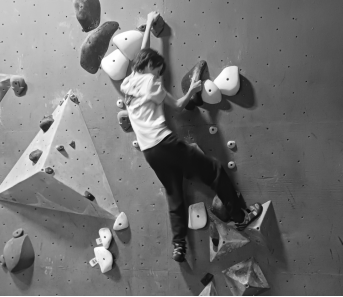
Climbing is a complex sport. However, the fundamental concept is very simple: There’s a wall with holds on it; to get from one hold to the next, the climber needs to complete a move — an action which translates at least one body part to a different hold. A move could be something as simple as an upward reach or the relocation of a foot to a better-positioned hold. Complicated moves also exist: mantles, in which the climber extends their arms downward, pressing on a hold to push their body up; dynos, based on the word “dynamic,” where the climber must temporarily give up all contact with the wall to reach the next hold — essentially a jump; campusing, climbing without feet on the wall, and many more. However, the sport’s true complexity only appears once moves are strung together into sequences, and, eventually, into routes: complete pathways up the wall.
When compared to other sports, one of the most distinguishing features of climbing is the near-infinite number of possible sequences. This means that climbers are constantly faced with new types of movement. “If you’re playing soccer or something, it’s always going to be the same field,” says Strahota. “(Climbing) has this sort of improvisation in it. You have to solve the route.” This problem-solving aspect appeals to many climbers. “I really like the puzzle of … figuring it out and getting a little bit better every time,” says Stephanie D’Cruz, a climber and English teacher at Grant.
Climbing’s complexity extends beyond sequences. Outdoors, different rock types can dramatically alter the feel of a route. Matt Stevens, a longtime climber and physics and chemistry teacher at Grant, says, “I don’t have a favorite kind of rock. I like how diverse rock is.” He specifically mentions the stickiness of granite, the interesting angles offered by columnar basalt and the careful footwork required to climb on limestone. In addition to climbing avidly for many years, Stevens also created the framework for competitive climbing in America by standardizing comp climbing procedures at a national level for youth in 1994; this structure eventually grew to include adult comps and became USA Climbing, the current organizing body for comp climbing in the U.S.
Grant is host to a significant number of climbers. As Strahota says, climbing is a “close community” built around a shared love of the sport. Similarly, Stevens says that he met many close friends through climbing. Although it may not be the most popular activity, the presence of a vibrant climbing community at Grant is undeniable.