

















For a natural process that affects those with a uterus for nearly half of their life, menstrual cycles are a pretty taboo subject.
The average American who menstruates will have a menstrual cycle for 37.5 years, or roughly 46% of their life. On average, they will have 480 periods in their lifetime. Given the average period length of 2-7 days, they will likely spend somewhere between 960 and 3360 days of their life menstruating. That’s between 2.6 and 9.2 years continuously bleeding.
During a menstruating persons’ four years of high school, they may have as many as 52 periods — as will many of their peers. No matter when a period occurs, it’s an obstacle, but the symptoms associated with periods affect nearly all menstruating Grant High School students in some way throughout the school day.
After forgetting to bring ibuprofen to school one day while on her period, anonymous Grant senior Student One writes that, by lunch, “I was dizzy and overheating, and just so out of it, so I went home.” Mya Sulaiman, a freshman at Grant, writes that she’s had to “walk around with so much cramp pain and not do anything and just endure it, because I know I can’t miss school, because then that will impact my perfect attendance.” Looking back at her experience in middle school, she says that she “wasn’t as scared to miss a school day, although I have always been the type to come to school on time, get to every class on time and not skip even if my period is, like, super bad.”
Sulaiman is not alone in her struggle to balance physical pain and attendance. Student Two, an anonymous Grant senior, writes that she has to “miss school due to cramps on the first day of every one of my periods,” and “cannot focus or participate in class or sports on the first day and a half.” Another anonymous Grant senior, Student Three, writes that she has “missed school at least fifty times over the course of high school” because of her period. Student Four, an anonymous Grant sophomore, writes that it’s “hard to focus when you are in excruciating pain also just walking to class.”
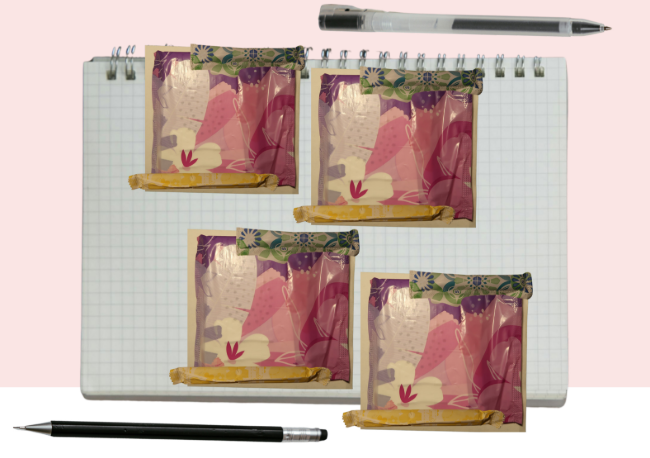
Grant’s nurse, Tegan Leipzig, says that periods are “a complaint I get almost daily.” Accordingly, she has a vast supply of products to support menstruating students: heat packs and water to help with cramps, pads and tampons in a variety of sizes and a clean change of clothes. “It is common for students to bleed through clothing or ask to go home due to discomfort,” Leipzig says. She can also help students call a parent or guardian to be picked up, offer advice on how to manage periods or write a doctor’s referral for students who need it.
An often overlooked element of menstrual cycles, though, is what happens during the three phases between periods. The hormonal shifts that occur throughout the cycle can have both physical and mental effects on menstruating students.
“I feel frustrated when I’m in my strength and conditioning class (because) my energy and muscular endurance is constantly being affected because of my cycle,” writes Grant senior Leisl Cockrell. “It’s frustrating because I’m not constantly at 100% endurance, because if we have max tests and I just happen to be in my luteal phase, I won’t perform at my highest energy and my max could even drop lower.”
Student Five, an anonymous Grant senior, feels significantly “more productive and motivated when ovulating.” Student Two tends to feel “more tired” and “significantly more emotional” during her luteal phase.
Grant senior Rain Hoogen often feels “really sad and nostalgic” the week before their period; however, they feel that the emotional shifts attributed to menstrual cycles are overstated. “I hate when men think women are always b*tches on their periods,” they write. “I personally have never felt like I’m ‘more b*tchy’ on my period, or have felt that way about any of my friends. I don’t get where the stereotype came from, and it truly just is a way to blame women’s feelings on themselves.”
Despite the shared discomfort of having a period, open discussions about it are uncommon.
Perhaps the brevity of health education is part of the reason. “I’ve had very informative health classes that have taught me a lot of stuff, but I do wish that there was a bit more focus on the menstrual cycle, especially since it affects like half of Earth’s population every month,” writes anonymous Grant junior Student Six. Student Four writes that she wishes health classes spoke about menstruation more, “not just so girls can know what to expect but also so boys will be more understanding.” Student Two agrees: “Everyone should know more about it, especially boys.”
Another factor at Grant could be the lack of a distinction for menstrual-related symptoms in the absence-reporting form; instead of reporting cramps directly, a student must write themselves out as “ill.” Grant seniors Olive Raak and Margot Kalmanson, co-leaders of Grant affinity club UterUS, had a discussion with Grant Vice Principals Luis Jara and Jessika Magnett during a club meeting on Jan. 29 to pitch possible changes to the policy. Rather than “hiding it under illness,” Raak writes, “giving the option of period cramps on the attendance form normalizes it, so non-menstruating students see it and think about it.”
Embarrassment or fear of judgement from peers or family could also factor into the societal avoidance of discussing menstruation. The perceived awkwardness of reaching out for help leaves many feeling like figuring out how to manage their period is “a discovery you have to make on your own,” as Student Seven puts it, rather than a well-researched process that women have dealt with since the birth of humanity.
Discussions on the dangers of certain products without the presence of an authority of truth has fostered uncertainty, distrust and fear for many Grant students. “On social media everyone is saying ‘These products have microplastics’ or ‘Using tampons this way gives you toxic shock syndrome,’” Hoogen writes. “It just feels like every product has something ‘wrong’ with it.” Student Six feels similarly: “I’ve briefly seen studies on heavy/toxic metals found in tampons which makes me hesitant to try different products and brands,” she writes. Student Five has been using tampons out of habit since she did ballet, yet is still affected by this information. “I’ve never tried anything new, but sometimes I see stuff about there being weird chemicals in tampons and it worries me,” she writes.
How should this be amended? Student reflections indicate that education is the answer. “I’m lucky to not have really intense cramps or bleeding, so I didn’t have to learn much,” Hoogen writes. “However, I find I was always lacking in education about why periods happen, and most of my knowledge on different period products and how to use them came from social media.” If that source could be shifted to a more reliable one, the issue of distrust could be addressed.
Although the menstrual cycle is already covered in health classes, Grant students feel like its content could be altered to promote better education on the subject. “I feel like the actual phases of the cycle have been explained to me through health classes, but how to navigate a period or what to expect has never been explicitly shared with me,” writes Student Seven. “I’ve figured most of those things out on my own.” Student Five points out areas of menstrual health that health classes place too much focus on, writing that since fifth grade, “health class has been so focused on like drugs, alcohol and sex with very little covering menstruation or cycles (besides having to do with fertility/pregnancy).” Student One writes that her mother “didn’t know about the other phases besides menstrual until recently.”
Others, like Student Three, believe the information offered in health classes was helpful, but that the timing could be better. “I think health class was very informative, but I wish I was able to take a class that covered periods earlier on,” she says.
That menstrual health is uncomfortable to talk about for students at Grant — and people in general — is an undeniable, but not inherent fact. Many Grant students agree that early, comprehensive education is essential to reverse this stigmatization of a normal process.
Sulaiman puts it simply: “I need to make sure I know that I’m doing the right things with my body.”