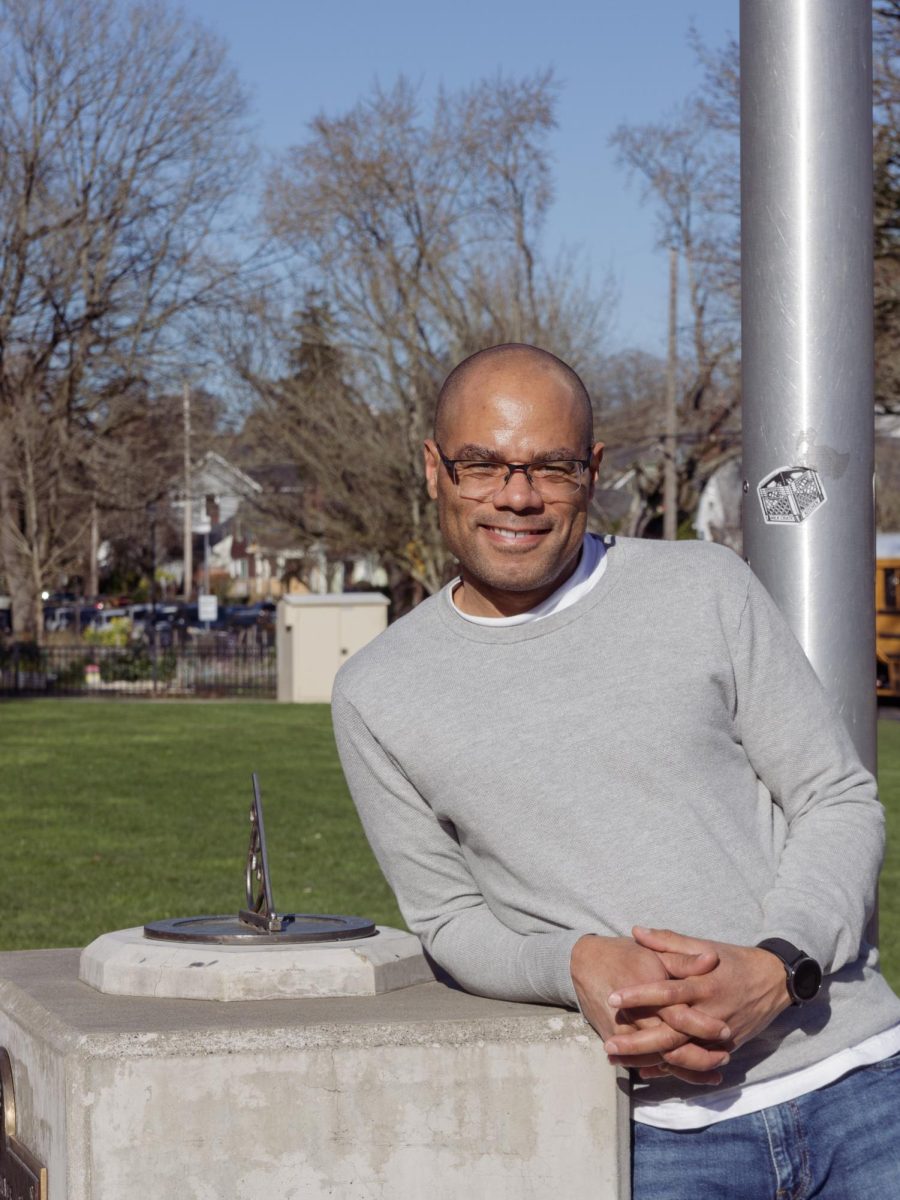












Warren A. Hatch has spent 30 years substituting for teachers in the Portland Public Schools (PPS) district. In this time, he has worked at every elementary school in Portland and integrated his own work into lessons for nearly every class, sharing pages from his books about the bugs in his backyard.
Hatch obtained a teaching degree at Portland State University, but started off working as a substitute in the Los Angeles Unified School District. While in California, he began making films through microscopes to present to students. “The kids would try to guess what it was, and then after about a couple of minutes, you back up and you see the fly,” he says. “And kids love that.”
Hatch’s interest in the environment, and specifically bugs, runs back to his childhood. “My mother was an assistant professor in the biological sciences at Washington State College … and my father just loved nature,” he says. “Both my parents love nature, and they were always interested in it. And so I’ve always been curious.”
But after years of capturing videos of insects for his students, Hatch began to notice their quality degrading. “When I would look back at the films that I had made 15 years ago, it would be grainy because the resolution on projectors and TVs got so much higher that when you look at the old ones, it looks all grainy,” he says. “I decided to switch over to print, because if you make a really high-quality print book, 100 years from now, it can still be magnificent.”
His first book, “In One Yard: Close to Nature,” was published in 2015. “I worked like three or four years on that, taking the photographs and writing and researching and so forth. I was very, very proud of it,” Hatch says. It was chosen as “one of the best science books of the year” by the review journal Science Books & Films.
After Hatch sent him a copy of the book, world-renowned naturalist and broadcaster David Attenborough wrote him a “wonderful” handwritten note. In a review of Hatch’s book for The Oregonian, Sally Peterson writes that the “myriad of photos of endearing spiders, harvestmen (“daddy longlegs”), mites and pseudoscorpions will hopefully help more gardeners learn to appreciate, rather than fear, these fascinating, and in many ways beneficial, organisms.”
As of December 2025, Hatch has finished compiling his second book, which includes new information on “lichens, mosses, fungi, seeds and liverworts,” he says, and started working on a third.
Before PPS, Hatch substituted in East Portland, where he became good friends with teacher Ned Leager at Alder Elementary School. “It was easy to become friends with him,” Leager says. “If you’re interested in his work, he’s so outgoing and sharing.”
More than that, though, Leager points out that Hatch’s devotion to nature goes beyond his work. Hatch has lived car-free for 41 years, preferring public transportation or walking over driving. “I like moving around rather than getting cramped in a car, and I think it’s also better for the environment … and allows me to get really high-quality equipment,” Hatch says. Also a vegetarian, Hatch regularly cooks his own meals. “Everybody needs to do their part to decrease global warming,” he says.
Leager admires the lengths Hatch has gone to on behalf of the environment. “I think of him as a hero,” he says. “He’s really an example of somebody who’s inconvenienced himself … But he’s making that sacrifice because he believes so strongly in nature.”