


















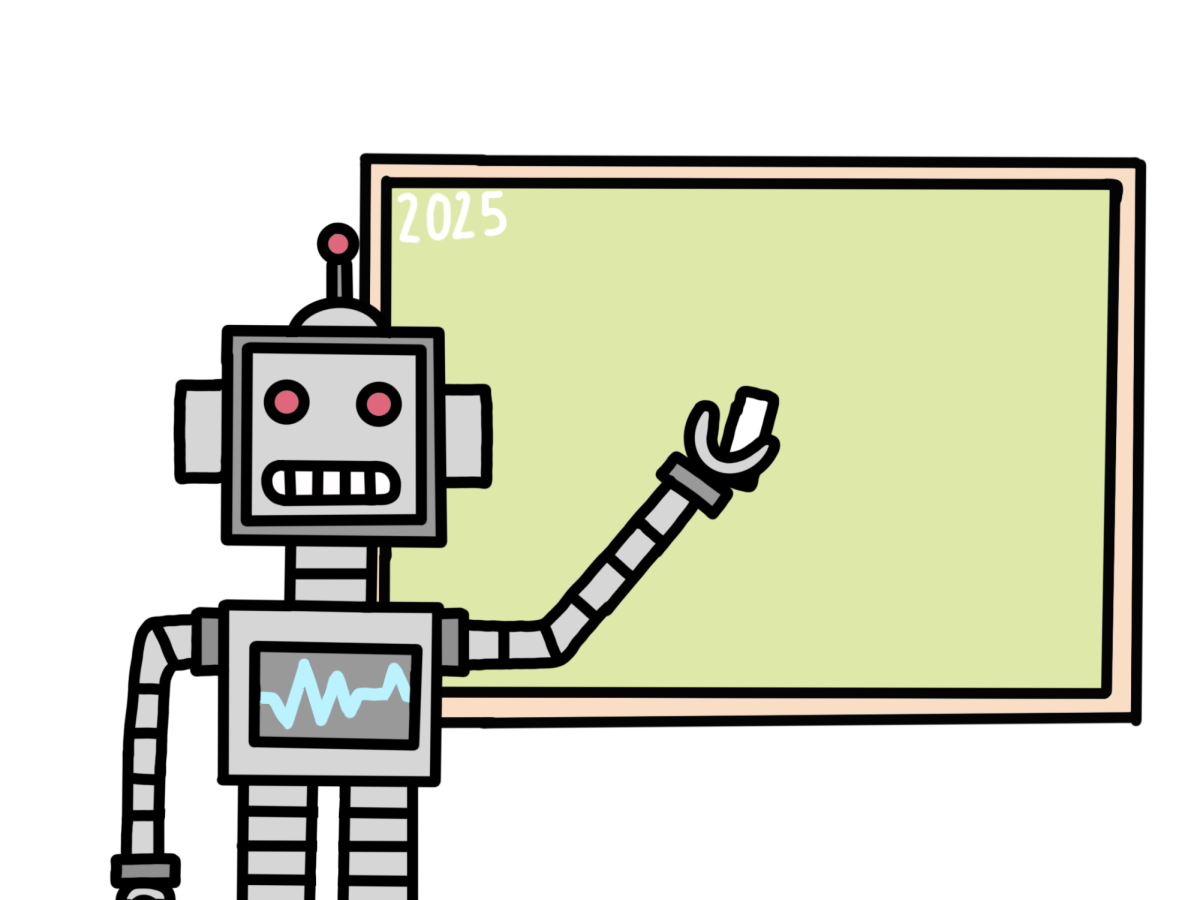
In late November 2022, the academic world was turned upside down by the release of ChatGPT, a generative artificial intelligence (AI) program created by OpenAI. The program quickly attracted public attention for its ability to generate unique work that students can claim as their own. Never before was such an effective tool for cheating so accessible. Teachers and administrators were left scrambling to find a solution.
Portland Public Schools’ “Responsible Technology Use” policy prioritizes safe and inclusive learning, but does not mention AI. This open-ended policy gives teachers quite a bit of leeway and puts no regulations on the use of assistive AI by teachers in classrooms.
Grant Magazine reached out to multiple teachers after hearing from several students that they openly use AI to generate assignments, but all declined to comment. A student of one such teacher agreed to an interview under the condition of anonymity.
The student says that her foreign language teacher “never seems like he has any negative connotations with him using AI,” despite his frustration when students use such programs to cheat on assignments. She feels that AI is harming her and her peers’ learning experience in the class because of its inaccuracy and inability to correctly use the vocabulary words it is supposed to be teaching. The experience of having to use material generated by ChatGPT as a reference, just to find out it’s wrong and must be redone, is very frustrating to her. “You just think, ‘Oh, my teacher doesn’t even put in the time to make example sentences, and he wants me to do two hours of … homework,’” she says. “It just feels really unfair.” The student thinks that teachers should review the material before showing it to their class and inform students when content is generated by AI programs. She believes transparency is vital to prevent excessive dependence on the tools. “I think there’s definitely positives and negatives to AI,” she says. “It’s so important to hold yourself and other people accountable for (using) it so that it doesn’t become really out of hand.”
Christian Jarquin, an English teacher at Grant, doesn’t have an issue with educators using AI to enhance their lessons, comparing it to Google. The important thing, he stresses, is to make sure the material being taught is accurate. Isaiah Creel, another Grant English instructor, says, “Teaching English is not just about grammar, or pronunciation or even reading. English is a system of communication … if that communication is done between a human being and a computer, it’s not giving students the same practice that I’ve basically been hired to do.”
Although Jarquin is open to using AI as a search tool, he also acknowledges its limitations, describing it as “just a starting point” for further research. Comparing generative AI to the popular website Wikipedia, he emphasizes the importance of cross-referencing either platform when using it for research. If used appropriately, Jarquin sees AI as a tool that can benefit learning.
When it comes to students using AI to write their papers, Jarquin will turn to online AI detectors if he suspects a student’s work is not their own. “I’ll use a few of them if I suspect a (student) is using AI,” he says. But he also recognizes that detectors can often be inaccurate, and always reads papers himself before confronting students.
While Creel and Jarquin hold different philosophies on the application of AI in the class room, neither use the tool to generate lesson plans. Creel finds such a use to be a “surrender of reason,” and says AI “has forced teachers to reckon with their practice and find out what makes a good teacher … and what makes somebody that doesn’t deserve or have any right to be in the profession at all.”
Despite his personal stance against using AI to teach English, Creel says that “each person that is employed here at Grant High School is thinking about students and their futures, and what it means to be a student, what it means to be an educator and how best to serve students.”