








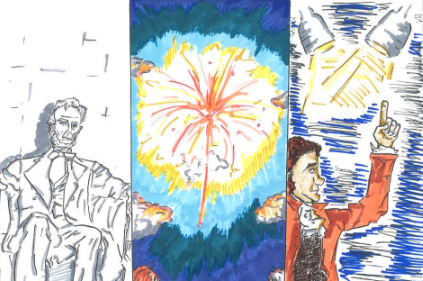


This year, Grant High School’s annual Grantasia production featured a performance based on drawings by a twelve-year-old boy named Micah. According to Jessica Murray, Grant’s dance teacher, Micah is a bright boy who loves drawing, singing and math. Micah’s drawings, inspired by Camp Simcha, which he calls “Happiness Camp,” guided the choreography, costumes and set design for the piece. The performance was made up of 29 dancers, all a part of the Grant Dance Collective, and a total of around 500 students, all of them in the performing arts program at Grant.
The performance was a collaboration with Sing Me a Story, a nonprofit organization aiming to bring joy to “kids in need” by turning their stories into written songs.
According to Grant Choir Director John Eisemann, Micah is very close to his two brothers, one on the autism spectrum and the other diagnosed with a rare neurological disorder. Eisemann says Micah is “very protective” of his brothers and “feels a lot of responsibility” for them.
The choreography was developed directly from Micah’s drawings, which included bright colors, airplanes and a tunnel that was very meaningful to him. These visuals inspired the use of an oversized blue tunnel onstage, along with costumes meant to match the colorful, playful look of his art. Murray says the dance focused on the ideas of celebration, joy and purity, as well as Hanukkah. She explains that the dance was “celebrating Micah for exactly who Micah is.”
The music is an original piece composed by Judy Rose, an experienced Portland composer and music teacher at Catlin Gabel School. Rose has assisted with many productions at Grant in the past and is a friend of Eisemann, who first presented Micah’s story to her.
Murray says the tunnel was a major focus of the performance: “We’re basically looking at every possible creative way we can work with it and with each other,” she says.
Murray additionally aimed for the Hanukkah-related themes in the dance to ensure Grantasia emphasized aspects of the winter season beyond Christmas. In addition, she hopes the audience related to the “innocent joy of childhood” presented in the performance.
“Music can be about anything, and it can showcase a wide range of human experiences,” Eisemann says, adding that the collaboration is “an opportunity to explore the perspectives of … kids who sometimes feel like they don’t have a voice in society.”