












Early on Saturday mornings, vendors, volunteers and community members come together in the parking lot of a Grocery Outlet in Northeast Portland to take part in the Hollywood Farmers Market.
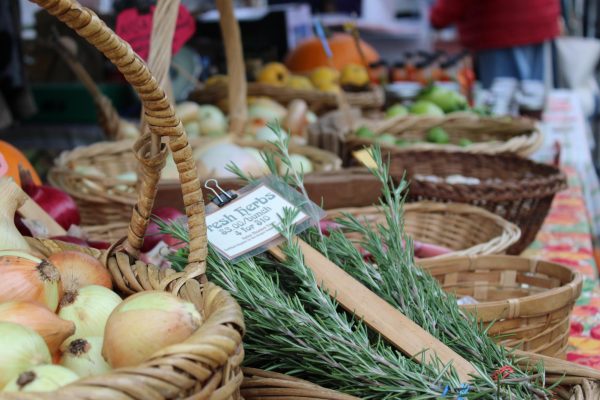
In its 29 years of operation, the Hollywood Farmers Market has established itself as a year-round staple of the Portland community, regularly involving over 100 different vendors. Yet the first market, held in 1997, had just 10. As it’s grown in size, the market has also expanded to provide a variety of different products, from fresh produce and hot food to artisan goods and crafts such as wooden spoons and beeswax candles.
The Hollywood Farmers Market has been in constant change since its inception. Jeff Rosenblad, a founding vendor, has noticed this evolution both within his own stall and in the habits of customers. His farm, Happy Harvest, has become one of the largest berry fruit vendors at the market. Yet, with the increasing availability of produce, he has noticed a difference in customer buying patterns. “People used to come and buy larger quantities of things to store,” he says. “Now you can buy blueberries, strawberries and raspberries year round, so people don’t tend to freeze them like they used to.”
Changes sparked by the passage of time were heightened as the market continued running through the COVID-19 pandemic. “Everybody sort of reprioritized the way that they were doing their shopping,” says Laurel Burblinger. She works on a small family vegetable farm that has been vending at the market for 25 years. In order to keep the market going during the pandemic, only a certain number of people were allowed in at a time, causing long lines to form at every entrance. “Everybody was still willing to wait, and that was sort of a shift,” says Burblinger.
According to Executive Director Kyrsten Williams, the market is intentionally low-barrier for vendors. “It’s incredibly expensive to run a business, and things just keep getting more expensive. And here, people don’t have to pay monthly rent,” she says. “They’re not paying for a brick and mortar … They’re popping up a tent once a week, and we charge $50-$60 per space per week, so it’s this really low overhead where people can come and our farmers can make thousands of dollars each week.”
This system allows vendors to become established within the market, forming their own connections with the community. Rosenblad has experienced this with the growth of his stand. “We still have customers that have been here since the first day,” he says. “We’ve gained a lot of friendships. A lot of kids have worked for us from families that buy.”
Other vendors have experienced this enduring aspect of the community as well. Steve Mallinson, owner of Sea2Spoons, handmakes utensils and tableware out of wood and sells them at the market. “I love the fact that people come by and say, ‘Oh, I love your spoon. We use it every day. We bought some from you last year. We’re going to buy some more for friends.’ I mean, it’s unbelievably supportive,” he says.
The unity of the market extends beyond its customers. Natalie Powell, a worker at single-origin chocolate shop Ma Cacao, describes the shared customs between vendors. “Within the market itself, it’s such a community. There are trades that happen, vendors give vendors discounts,” she says. Powell herself began working at Ma Cacao because she often saw the stall during her visits to the market. “I really loved the product, and it had a ‘we’re hiring’ sign. And I was like … ‘I spend most of my weekends at the market anyway. Might as well do it,’” she says.
The Hollywood Farmers Market also directly supports its community and customers through food access programs: The market has had the ability to process Supplemental Nutrition Assistance Program (SNAP) cards for over a decade, and also has a program called Double Up Food Bucks, run through the Farmers Market Fund, that matches customers’ SNAP money up to $20.
When SNAP was disrupted in November 2025 due to the U.S. government shutdown, the market came together to raise money for those who lost access to their funds. “We ran an emergency fundraiser … For
all of November, we were giving out $20 in tokens, and Farmers Market Fund was still allowing people to get $20 in the match, even if we weren’t swiping people’s cards,” Williams says. This fundraiser resulted in the market distributing over $11,000 worth of tokens to those in need.
Williams hopes to continue efforts to combat the uncertainty of SNAP’s future. She says November’s fundraising campaign was a “good experiment” to see how the market can finance this supplemental
assistance.
People working at the market have also noticed the benefits of its inclusion of SNAP. “It allows the farmers market to be accessible and not only a place for rich people to go,” Powell says. “There’s sort of that exposure and educational component there that I think really, really helps with knowledge and health equity.”
The Hollywood Farmer’s Market also supports the community by providing a reliable source of fresh produce. According to Rosenblad, the relationship customers build with the farmers gives them assurance that they are getting safe and high-quality food.
Burblinger stresses the importance of fresh food in a world dominated by grocery store produce. “Even though this may be more expensive than produce you buy in a grocery store, any grocery store really, you know that it’s fresh, because it has to come from this area to be available at the farmers market,” she says. “Oftentimes vegetables are treated at big grocery stores to be able to have a longer shelf life, and that takes some of the nutrition out of them.”
For vendors such as Ma Cacao and Sea2Spoons, the produce-dominated nature of the market presents a unique opportunity. “A lot of farmers markets are super heavy on produce, but I think it’s always fun to see value-added products,” Powell says. “I think that’s kind of what we bring to the market. We offer that very unique, indulgent product.” Mallinson appreciates that the market is opening up more to crafting vendors. “They’ve changed the model of the market, and they’re going to allow crafts people in all year round,” he says. “That way they’ll have a little variety as well as just food.”
This inclusivity allows the Hollywood Farmers Market to hold significance for every type of vendor. Both Powell and Burblinger remember it fondly from being raised nearby in the Hollywood neighborhood. “When I was growing up, this was our local farmers market, and I remember coming here in a red wagon,” Powell says. “It was the highlight of my weekend, because I got to ride the wagon and then go run around and try all the free samples from all the vendors.”
Vendors and customers alike have found a real community through their time at the market. “I think it’s a very rare space that people can come and connect to each other and to resources and to their growers and makers. It doesn’t really exist anywhere else. It’s kind of this point of contact that you can have with your neighbors that is rare to find,” says Williams.
Powell also finds the Hollywood Farmers Market to be a unique and special gathering place in terms of products and social connections. “I love the farmers market,” she says. “I think it’s the heart and soul of every community.”