





















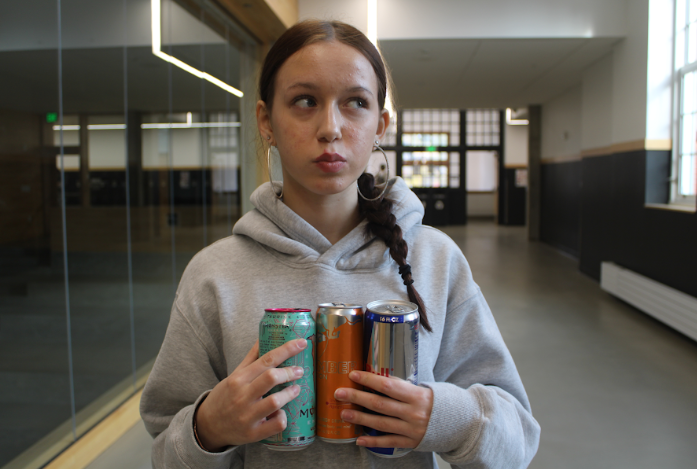
From Celsius cans on classroom tables to Red Bull sold at the Student Store, caffeine culture is prevalent at Grant High School. But how much energy is too much?
Energy drinks were not always popular in schools. Before the emergence of Red Bull in 1987, the market for them was practically non-existent. But in the subsequent 38 years, there has been a significant increase in the quantity and variety of energy drinks being sold. Some are marketed as health-conscious drinks, whereas others are advertised to increase focus and improve athletic performance — and some are simply a trendy, flavorful energy boost.
Russ Peterson, a social studies teacher at Grant, believes that energy drink culture has become more relevant since the pandemic. He has also observed upperclassmen with heavier workloads often drinking more caffeinated drinks. Like most teachers, he occasionally questions the nutritional aspect of these drinks, but also acknowledges the academic stress that students are under. “I can’t blame or fault or have issues with my students wanting a caffeinated drink. You know, I also drink caffeinated beverages. I think the only concern that I would have would be the other artificial ingredients in the energy drink,” he says.
The primary market for energy drink companies is teenagers and young adults. They appeal to this crowd using colorful cans, fun flavors and social media campaigns. These marketing strategies have been highly successful, with an estimated 30-50% of adolescents regularly consuming energy drinks.
Until he began teaching, Grant English teacher Jayme Causey never drank energy drinks. “A couple years into my teaching career, as I got older and more tired, as tends to happen, I was like, ‘I need something,’” he says. “It’s kind of a double-edged sword … It’s positive because I need them and they help me get through, but I wonder if I need them, because I drink them so often.”
Causey believes it’s a good thing that he waited to consume energy drinks until adulthood. “I just think that teenagers should be careful with their energy drink consumption just because A, it can form lifelong habits, and B, they’re not very helpful and healthy for you,” he says.
Increasingly, teens have also started to turn to energy drinks. This popularity comes with concerns, as teenagers have a lower caffeine threshold than adults. Additionally, over 70% of teenagers struggle with sleep deprivation, correlating with higher vulnerability to caffeine addiction.
Despite their negative effects, energy drinks can be found in nearly any store, from CVS to the Student Store at Grant, which operates during FLEX and lunch. There, students can buy energy drinks or caffeinated sodas like Celsius, Red Bull, Alani and Sparkling Ice. Grant Senior and Student Store Marketing Manager Luke Histand notices “an increase in those types of purchases during finals week and when quarter grades are about to end.” What Histand picks up on is a tendency of Grant students to turn to caffeine to make up for late-night study sessions and missed sleep. The normalcy of caffeine dependency among students increases the risk of them exceeding recommended caffeine servings: On average, an 8 oz. energy drink contains 80-150 mg of caffeine, equivalent to one cup of coffee. While this amount is fine for adults, the recommended caffeine intake for adolescents is under 100 mg per day. Continually exceeding this limit could lead to heart issues and other health concerns.
Grant sophomore Kiyomi McCollister had to turn away from energy drinks because of their impact on her health. “I used to drink energy drinks every time I had to study late at night or I knew that I had a lot of work to do,” she says. “I went to the doctor one time, and they told me I was not allowed to drink energy drinks anymore because of a heart issue that I have.”
While McCollister tries to replace energy drinks with caffeinated tea, they still fill a role in her life — just less frequently. “I know that if I got maybe three hours of sleep, that matcha is not going to help me stay awake at school, so that’s why I (still) drink energy drinks,” she says.
An energy boost after late night studying isn’t the only reason Grant students consume energy drinks — for many of them, energy drinks have become an essential part of their day-to-day lives. Grant sophomore Bea Remy consumes energy drinks regularly: She drinks two energy drinks and one cup of coffee every day. After drinking energy drinks for a year, she says that her tolerance has heightened drastically, along with the negative effects of not having the drinks as often. “I’ve tried to quit multiple times because it’s honestly really expensive buying so many energy drinks, but I just get really bad withdrawals with a lot of intense headaches and feel angry the whole day,” says Remy.
An especially dangerous aspect of energy drinks is what they are often used to replace: sleep, hydration, and nutrition. Deficiencies in these bring their own harmful effects for teenagers. Grant’s athletic trainer for the past 11 years, Ashley Heclock, says that “we probably don’t drink enough water, in general, as a society, so adding extra caffeine on top of it is probably not helpful.” According to Heclock, even though many athletes use energy drinks to maximize their physical energy, it tends to backfire on them with side effects like dehydration and increased anxiety.
Grant students have experienced many negative effects when it comes to consuming energy drinks. However, when heavy homework loads and extensive extracurriculars make getting enough sleep near impossible, a need for the caffeine they offer remains. Among adolescents, energy drinks are far from being a trendy fad; they seem to be here to stay.