


















lex Sahli, a Grant High School alumnus, created an online design out of LEGO bricks that was recently chosen to become an official LEGO set. His set was one of the few selected through LEGO Ideas, a program where LEGO enthusiasts can submit their own designs to become a “Fan Designer.”
The set, which includes 3,251 pieces and 10 minifigures, is composed of three colorful buildings built in the style of Cinque Terre fishing villages in Italy. The buildings can be taken apart to reveal their interiors, which include a gelato shop, a fish market and an apartment. The outer landscape features a cobblestone street and a rocky beach.
“(It was) definitely a dream, but one that felt very far-fetched a lot of times — but I’m glad I stuck with it, because it paid off,” says Sahli.
The idea for the design struck him before a family trip to Italy in 2022. In his excitement, Sahli began researching the local architecture and geography. The villages of Cinque Terre stood out to him in particular.
“The real villages of the Cinque Terre are so colorful and bright, and they have fun angles, and they’re kind of crowded and chaotic in a good way — and that’s all the stuff that translates really well into LEGO, because LEGO is all those things,” says Sahli.
He started creating the initial design in the lead-up to his family’s trip. It took around a week to finish, but he wasn’t done yet. After the trip, he added to the project by incorporating a grassy hill and trains to represent the landscape and mode of transportation between villages. On top of the hill, he included a stone castle tower similar to those found in the area. Sahli’s favorite additions were satellite dishes and television antennas. Despite their contrast with the natural beauty of Cinque Terre, he says, “You see (them), and it brings you back to reality. You’re like, ‘Oh, wait, this is a real place with real people in it.’ I just thought it’s an important detail that made it more authentic and realistic.”
Sahli did not originally submit the additions of the hill and stone tower to LEGO Ideas, so they weren’t considered for the set. However, the satellite dishes and antennas made the final design.
“It was cool to work with (LEGO), because they’re the professionals,” Sahli says. “I love doing this as a hobby, but it’s really fun to see how they do it, and learn from them, and grow through that opportunity.”
As Sahli worked with the LEGO team, the design of the village went through a series of changes to make the build more accessible, such as making the roof construction sturdier and reducing the size of the beach. “With this program, the final design always changes from the original, because with the original design, you have a lot less constraints. You can use any piece LEGO’s put out,” he says. “When you have a LEGO set, like an actual set you can buy, there’s so many more constraints you’re working with, like what colors or what pieces are still available.”
Although parts of the design were altered, Sahli was able to include multiple details with personal significance. For example, tucked inside one of the buildings is a painting of a LEGO project Sahli had designed and submitted to LEGO Ideas that wasn’t selected to become an official set. Additionally, one of the minifigures in the set is Sahli himself, holding a camera and smiling.
“The hair is a little bit lighter because I sent them pictures and the lighting was strange, but I think I’ve just been out in the Italian sun for a little too long,” Sahli says. “But it’s very fun to see myself as a minifigure.”
Sahli started concentrating more heavily on designing LEGO My Own Creations — fan created LEGO builds — while at Grant. He began submitting designs to LEGO Ideas in 2021, and four of his six projects reached 10,000 votes meaning they qualified to be picked by LEGO to become an official design.
In high school, he enjoyed engineering and robotics classes with Nick Fenger and computer science with Doug Mandell. He valued how the classes allowed him to express his creativity and learn skills that were connected to building with LEGO bricks. “The stuff they teach kind of relates to (LEGO), and it’s definitely encouraged (me) to keep doing this,” says Sahli.
One of Sahli’s most cherished parts of Grant was its makerspace. The makerspace was a room in Grant’s basement containing creative supplies and technology such as 3D printers. The space and its coordinator were both cut due to budget restraints in 2024, but Sahli remembers them fondly. “The makerspace was something I was very excited about when I went to Grant,” Sahli says. “It wasn’t LEGO, but it was very much in the same realm … I think that should be encouraged more.”
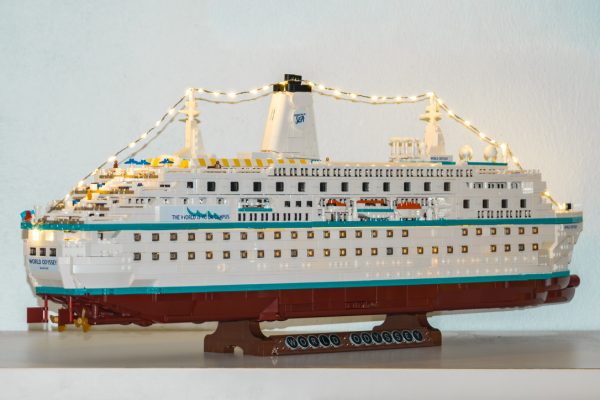
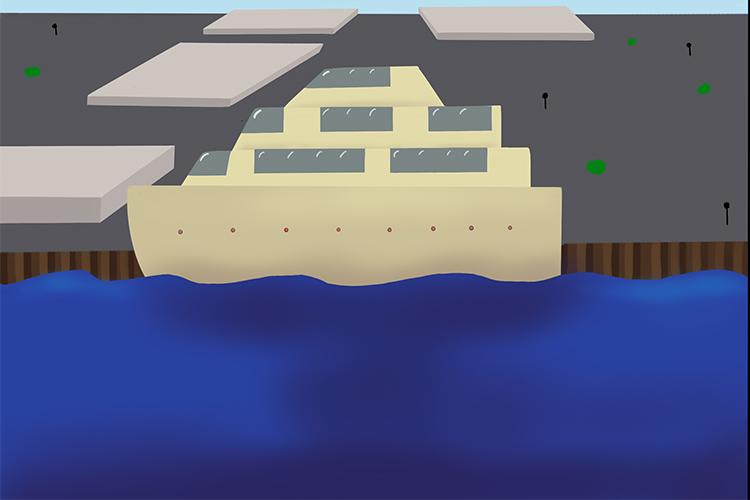
Sahli has continued to create many LEGO projects based on his interests and experiences. Two of his most ambitious ideas include a large cruise ship and a 15,000-piece map of Hyrule, a fictional world from the video game “The Legend of Zelda: Breath of the Wild.” Sahli used his online design to build the cruise ship, which turned out to be nearly three feet long. He hasn’t taken the time to actually build the map of Hyrule yet, but he created a set of instructions on the
LEGO design software Stud.io so that other builders could.
“Other people have built it, which is cool to see,” Sahli says. “This random German dude built it and then published an hour-long YouTube review — all in German —and displayed it at a convention, too.”
Building with LEGO Bricks can be costly, so Sahli uses Stud.io to design his ideas. He discovered the program during the COVID-19 pandemic when he was struggling to put the pieces he owned together in meaningful ways — Stud.io gave him free access to every piece in existence. “Turns out I didn’t have a creativity problem. I just barely had any pieces,” Sahli says.
Now, Sahli attends California Polytechnic State University, San Luis Obispo, where he studies computer science. Despite his demanding schedule, he still finds time to do what he loves. He recently worked on a commission project for Stanford University, for which he designed a realistic coral reef ecosystem to educate people about coral through LEGOs.
Released on Aug. 10 to the general public, the Italian Riviera set retails for $299. When it was published, Sahli received 10 free copies of the set. As the set continues to sell, he will receive 1% of each sale made. He also hosted a signing event at the Washington Square Mall LEGO store.
“Walking into a LEGO Store and seeing it on the shelf, and signing copies and having people come up and take their pictures has been a strange experience,” he says.
Sahli encourages those with an idea to consider submitting it to LEGO Ideas, but also acknowledges that it’s a very competitive program and the odds of an idea being picked, or even reaching the required 10,000 community votes to be considered by LEGO, are low. Despite this, he says, “There’s no way of knowing what’s going to be a successful idea.”